

Table Project to Project Copy
Description
Section titled “Description”Copies a table from one project to another. Use it to pull a shared reference table, a published result set, or a dimension-backed lookup between projects without exporting to a file and importing it back.
Both sides are named explicitly — a source project and table, and a target project and table. The target project starts as the current project, but can be any project, so a step can copy into this project, out of it, or between two others. The target table is created if it does not exist, and must be a table rather than a view.
Data Sharing Management
Section titled “Data Sharing Management”A copy needs up to two data shares:
- Read, from the source project to the target project, so the source’s data lands only where the source shares it. Open the source project’s Home tab, and under Data Sharing Management click New Data Share, select the target project, tick Read under Allowed Operations, and click Add Data Share.
- Write, from the target project to this project — the project the workflow is in, which does the writing — when the target is another project. Open the target project’s Home tab, and under Data Sharing Management click New Data Share, select this project, tick Write under Allowed Operations, and click Add Data Share.
So a copy into this project needs only the Read share, and a copy within one project needs neither. See Sharing Data Between Projects.
Without a share it needs, saving the step is refused and a run fails, with a message naming each share to add — for example Project ‘Sales’ can’t write to project ‘Finance’: in project ‘Finance’, under Data Sharing Management, add a data share for ‘Sales’ that allows Write. A refused run leaves the target project as it was, without creating the target table. A project given as a variable is checked when the step runs.
The step runs as this project’s own identity, so a run works through the shares whoever starts it.
Copy Parameters
Section titled “Copy Parameters”Read From
Section titled “Read From”- Source Project — the project to copy from.
- Source Table — the table to copy, chosen from the source project.
Write To
Section titled “Write To”- Target Project — the project to copy into. It starts as the current project.
- Target Table — the table to write, chosen from the target project. Picking a different Target Project clears a table you chose from the old one; a table given by name or path is kept, and found in the new project.
- Append to Existing Data — tick to add the copied rows to whatever the target table already holds. Leave it unticked to replace the table’s rows with the source’s.
A saved project that you can’t see, or that has been deleted, is shown marked (missing) rather than being swapped for another project.
Common Configuration Items
Section titled “Common Configuration Items”Data Mapper Configuration
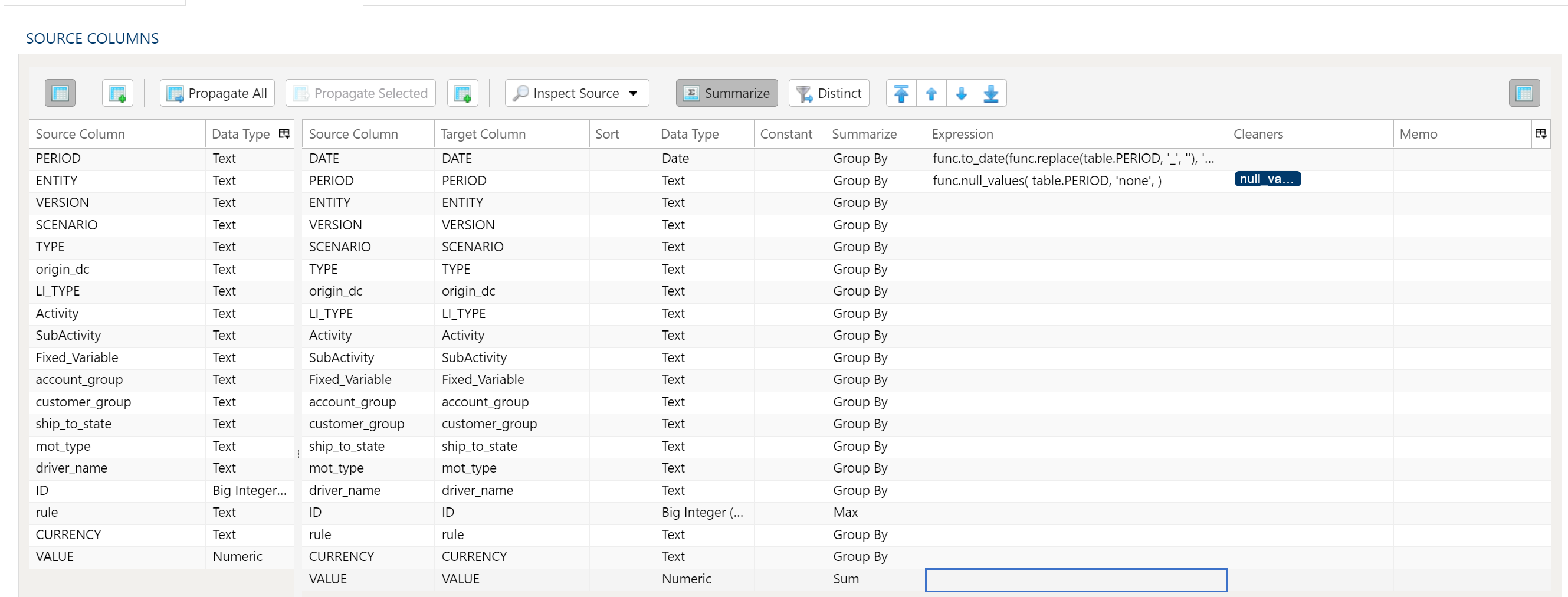
The Data Mapper is used to map columns from the source data to the target data table.
Inspection and Populating the Mapper
Using the Inspect Source menu button provides additional ways to map columns from source to target:
- Populate Both Mapping Tables: Propagates all values from the source data table into the target data table. This is done by default.
- Populate Source Mapping Table Only: Maps all values in the source data table only. This is helpful when modifying an existing workflow when source column structure has changed.
- Populate Target Mapping Table Only: Propagates all values into the target data table only.
If the source and target column options aren’t enough, other columns can be added into the target data table in several different ways:
- Propagate All will insert all source columns into the target data table, whether they already existed or not.
- Propagate Selected will insert selected source column(s) only.
- Right click on target side and select Insert Row to insert a row immediately above the currently selected row.
- Right click on target side and select Append Row to insert a row at the bottom (far right) of the target data table.
Deleting Columns
To delete columns from the target data table, select the desired column(s), then right click and select Delete.
Source Columns That Are No Longer Listed
A target row can name a Source Column that the source data table no longer lists, for example after the source was inspected again. The step never removes such a row for you. Instead, the column name is shown in red behind a ⚠ warning sign, and hovering over it says the column is not in the source columns. In a step with several tables, such as a union, each table is checked against its own source columns.
A row with a Constant, an Expression or a Count (including nulls) summary is never flagged, because the step doesn’t read its source column. Nothing is flagged while the source data table lists no columns, for example before the source is first inspected.
When you save a step that still has flagged rows, a Stale Columns Found dialog lists them under the tab or table they are on, and offers three choices:
- Remove All and Save — remove the flagged rows, then save.
- Save Anyway — save the step as it is.
- Cancel — go back to the step without saving.
To keep a row and clear its warning, add the column back to the source data table, or pick a column the source data table lists.
Column Data Type
Every target column carries a Type. A column propagated from the source keeps the source column’s type; a row you add by hand starts as Text, and you set Type to say what it should actually be — a column you intend to sum or sort needs its numeric or date type, because text sorts and sums as text.
A step saved with a column that has no type at all still runs. The type is worked out when the step starts, from the source column that column reads. Where there is nothing to read it from, it is treated as text: an Extract SQL step’s columns come from the query you wrote rather than from a mapped source, and where several sources carry the same column name under types that disagree, text is used rather than guessing one of them — a wrong guess produces a conversion the warehouse can reject, and anything converts to text.
Setting Type yourself is still how you say what a column should be. Leaving it unset means accepting whatever the source column happens to be.
Changing Column Order
To rearrange columns in the target data table, select the desired column(s). You can use either:
- Bulk Move Arrows: Select the desired move option from the arrows in the upper right
- Context Menu: Right clikc and select Move to Top, Move Up, Move Down, or Move to Bottom.
Reduce Result to Distinct Records Only
To return only distinct options, select the Distinct menu option. This will toggle a set of checkboxes for each column in the source. Simply check any box next to the corresponding column to return only distinct results.
Depending on the situation, you may want to consider use of Summarization instead.
The distinct process retains the first unique record found and discards the rest. You may want to apply a sort on the data if it is important for consistency between runs.
Aggregation and Grouping
To aggregate results, select the Summarize menu option. This will toggle a set of select boxes for each column in the target data table. Choose an appropriate summarization method for each column.
When Inspect Source fills the columns, a number column starts as Group By rather than Sum if its name reads as an identifier, such as id, customer_id, Order No or CustomerKey, if its table sets it as a key, or if the join uses it as a key.
- Group By
- Sum
- Min
- Max
- First
- Last
- Count
- Count (including nulls)
- Mean
- Standard Deviation
- Sample Standard Deviation
- Population Standard Deviation
- Variance
- Sample Variance
- Population Variance
- Advanced Non-Group_By
For advanced data mapper usage such as expressions, cleaning, and constants, please see the Advanced Data Mapper Usage