

Weave Tab — Read and Act on Weave's Findings
Description
Section titled “Description”Every project has a Weave tab that lists everything Weave has noticed about the project’s steps and workflows — the problems it found and the things it could not check — in Weave’s own words. From the tab you can read each finding in full, mark findings as read, open the step or workflow a finding is about, and open the AI fix assistant on a problem it can repair.
For what Weave checks and what its answers mean, see What Weave Checks. To ask the question finance teams ask on the days that matter — are the workflows a close depends on ready? — click Readiness in the tab’s toolbar; see Check Readiness Before a Close.
Open the Weave Tab
Section titled “Open the Weave Tab”There are three ways in:
- Open the project and select the Weave tab, next to Log.
- Click Open Weave on the message Weave shows when a workflow run ends. The tab opens on the findings about the workflow that ran, whichever app you were in when the message arrived.
- Follow a link to the tab. While the Weave tab is in front, the browser’s address bar holds a link to it, which you can bookmark or share with someone who can open the project.
The tab appears for anyone whose role lets them see the project’s steps and workflows; for anyone else, a link to it opens the project instead. Weave reads the whole project when the tab opens, so a large project can take a moment to list.
What the Tab Shows
Section titled “What the Tab Shows”Under What Weave noticed, the two lines at the top are Weave’s summary of the whole project: how many of its steps and workflows Weave checked, what it found, and what it has no rule for. They carry their own counts, so the findings below are never mistaken for a verdict on the whole project.
Filter the Findings
Section titled “Filter the Findings”The chips under the summary choose which findings are listed, and each says how many there are:
- All — every finding. This is where the tab starts.
- Needs attention — the problems Weave found.
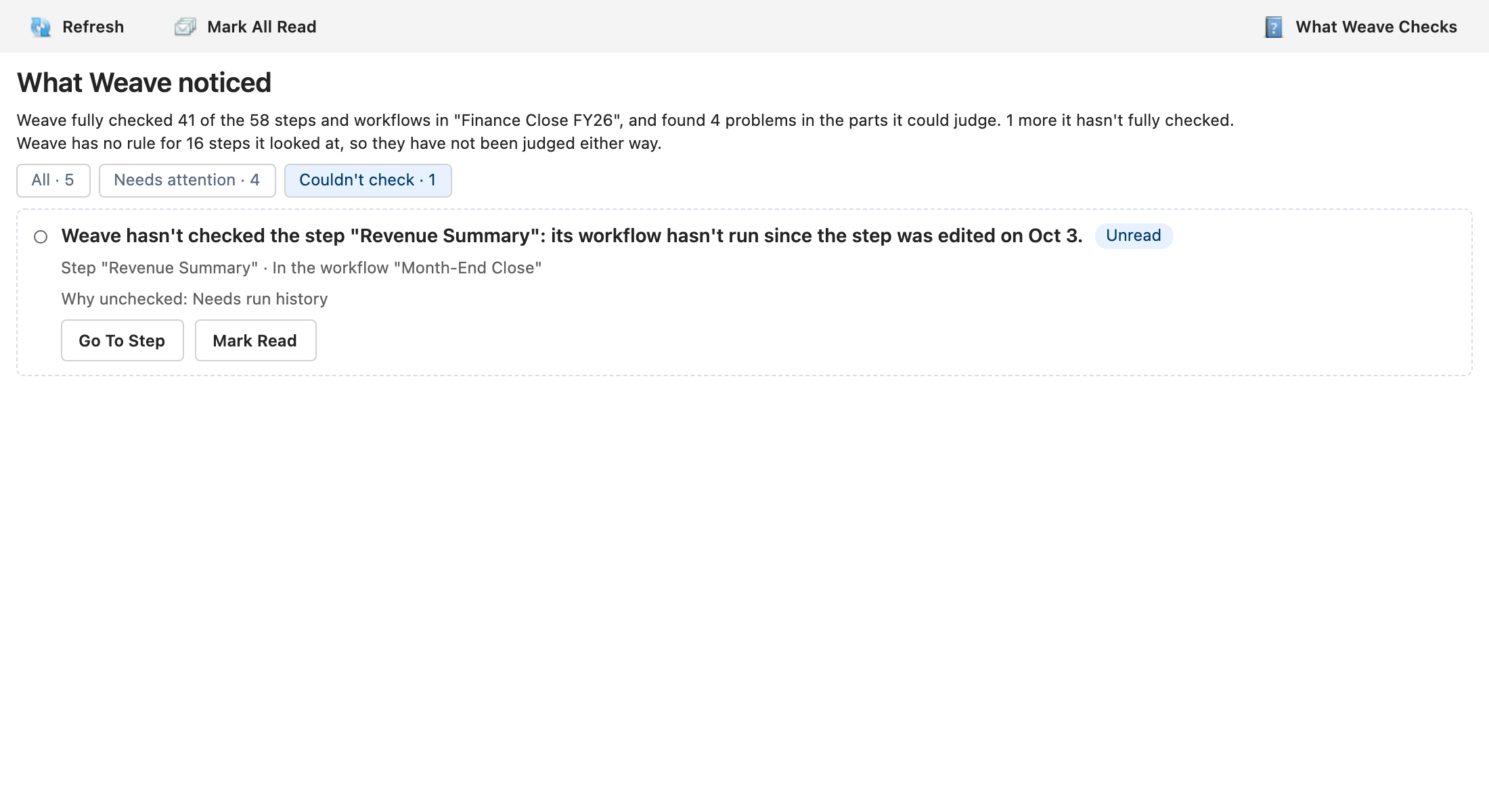
- Couldn’t check — the things Weave could not check.
When the tab shows one workflow’s findings, the counts are that workflow’s. A chip with nothing under it says so — for example Nothing listed under Couldn’t check.
Each Finding Is a Card
Section titled “Each Finding Is a Card”Problems are listed first and the things Weave could not check after them, in the order Weave reports them. A chip narrows the list but never reorders it.
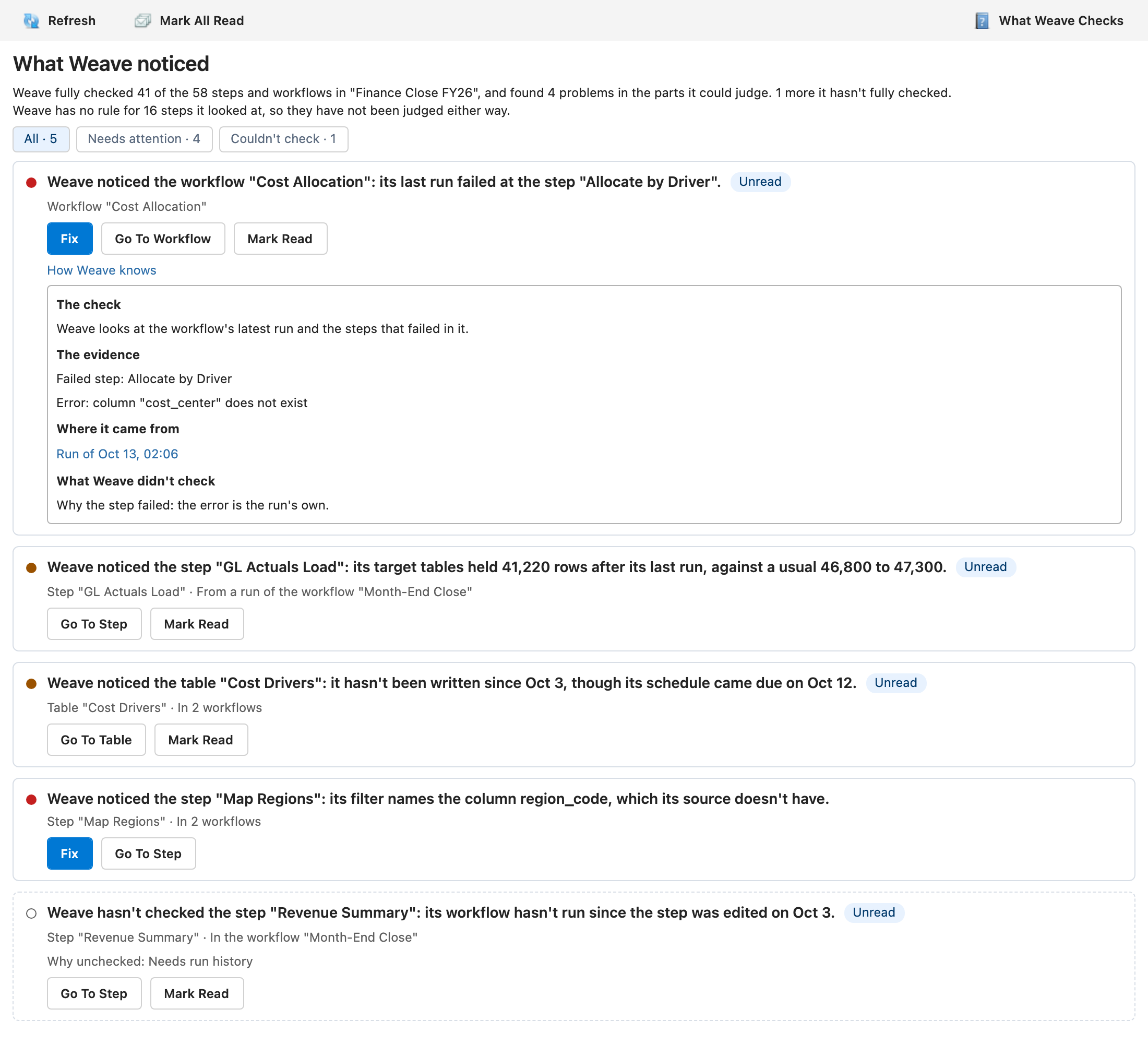
Each card shows:
- A mark — a red dot for a problem, an amber dot for something worth a look. A card for something Weave could not check has a dashed border and a hollow ring, so it never reads as a problem found.
- Weave’s sentence about the step, workflow or table, in full.
- What it is about — the step, workflow or table by name, then its workflow: In the workflow and its name, In 2 workflows for a step or table in more than one, or In no workflow. A finding about a step’s run says From a run of the workflow and the workflow whose run it was. A workflow your role doesn’t show you appears as a workflow you can’t see.
- Why unchecked — for something Weave could not check, the reason.
- Unread — until you mark the finding read.
- Buttons — Fix where the AI fix assistant can repair the problem, Go To Step, Go To Workflow or Go To Table, and Mark Read on an unread finding.
- How Weave knows — click it to open the check Weave ran, the evidence, where it came from and what Weave didn’t check. It starts closed. See How Weave Knows.
A large project can have hundreds of findings, so the tab lists 20 cards at a time. Click Show 20 More Findings at the end of the list for the next ones — the button counts down when fewer are left.
The reasons a card can give after Why unchecked are:
- Not fully set up — the step or workflow is saved but not finished, such as an allocation with an empty column mapping or a workflow with no steps yet.
- Needs run history — Weave needs runs it has no record of: the workflow hasn’t run in the last 30 days, hasn’t run often enough to compare against, or its runs carry no empty-value counts.
- Needs more context — Weave lacks something it needs, such as a variable that is set differently in each workflow the step belongs to, or run history it could not read.
- Configuration it can’t read — the step’s configuration is in a shape this check does not read.
- The check failed — the rule itself could not run. The finding names the check by its title, such as Last run failed.
Show One Workflow’s Findings
Section titled “Show One Workflow’s Findings”Clicking Open Weave on the message Weave shows when a workflow run ends opens the Weave tab on that workflow’s findings only, with a line above the list naming the workflow. The tab reads Weave’s findings again when it opens this way. A finding about a table is listed under each workflow that writes the table. Click Show All to see the whole project again.
A workflow with no findings shows No Weave rule reported this workflow, and beneath it what Weave has no rule for across the project. That means no rule reported the workflow, not that every part of it was checked.
Mark Findings as Read
Section titled “Mark Findings as Read”- Click Mark Read on a card. The card loses its Unread mark where it is, so a How Weave knows you have open stays open.
- Click Mark All Read on the toolbar to mark every finding listed under the chip you have chosen, including any further down the list than the cards shown so far. When the tab shows one workflow’s findings, only those are marked.
Opening the tab marks nothing read, and neither does being told about a finding when a run ends. Read state is yours alone.
A finding you have read can come back as unread. Weave treats a finding that says something new as a new finding — a run finding describes the run it came from, and a configuration problem that changes is a different problem — so it appears unread until you read it again. Findings about a workflow with no name or a duplicated step are identified more precisely than before, so some findings you had read can show as unread once. If a finding changed between the list loading and you marking it, the tab reloads the list.
Marking a finding read also stops it being mentioned in the message you get when a run ends. See Being Told When a Run Ends.
Go to the Step, Workflow or Table
Section titled “Go to the Step, Workflow or Table”Click Go To Step, Go To Workflow or Go To Table on the finding’s card.
- A workflow opens on its canvas if it is an Advanced workflow, or on its Steps grid otherwise.
- A step opens inside its workflow with the step selected. When the step belongs to more than one workflow, Go To Step lists them by name under the button and you choose which to open — Weave never picks one for you.
- A step’s run finding opens the workflow whose run it was, since that is the run the finding is about.
- A step that belongs to no workflow you can see opens on its own.
- A table opens in Table Explorer. Go To Table isn’t offered if your role can’t read the project’s tables.
Fix a Finding with the AI Assistant
Section titled “Fix a Finding with the AI Assistant”Click Fix on a finding’s card to open the AI fix assistant on it, in a window of its own. Fix is offered only on these findings:
- Allocation column mapping and Step expressions problems. The assistant starts from the problem Weave found in the step’s saved configuration.
- Last run failed, when one step failed in that run. The assistant opens on that step and starts from the error the run recorded. When several steps failed, fix each one from the project’s Log tab.
When the step belongs to more than one workflow, Fix lists them by name and you choose one, as Go To Step does.
The assistant proposes a change and applies it only after you approve it, as it does from the Log tab. See How It Works.
- If the step has changed since Weave reported the finding, the assistant says the finding is no longer current. Refresh the tab to see what Weave finds now.
- If a failed step has run again since that run, the assistant says the run’s error is no longer available.
- Each finding has a chat of its own, so you can keep several open. Clicking Fix on a finding whose chat is already open brings that chat to the front.
- Closing the chat reads Weave’s findings again, so a problem the fix resolved leaves the list.
See What Weave Did
Section titled “See What Weave Did”Click Activity on the tab’s toolbar to see the project’s history of what Weave noticed, proposed and changed, who approved each change and how it ended, and to export it as CSV or PDF. Click Findings to come back to the findings. See Weave Activity History.
When Weave Is Unavailable
Section titled “When Weave Is Unavailable”If Weave’s findings can’t be read, the tab says Weave is unavailable instead of showing an empty list, because an empty list would look like a project with nothing wrong. Click Try Again, or Refresh on the toolbar.
Click What Weave Checks on the toolbar to open What Weave Checks.