

WINDOW_FUNNEL (Lakehouse v1)
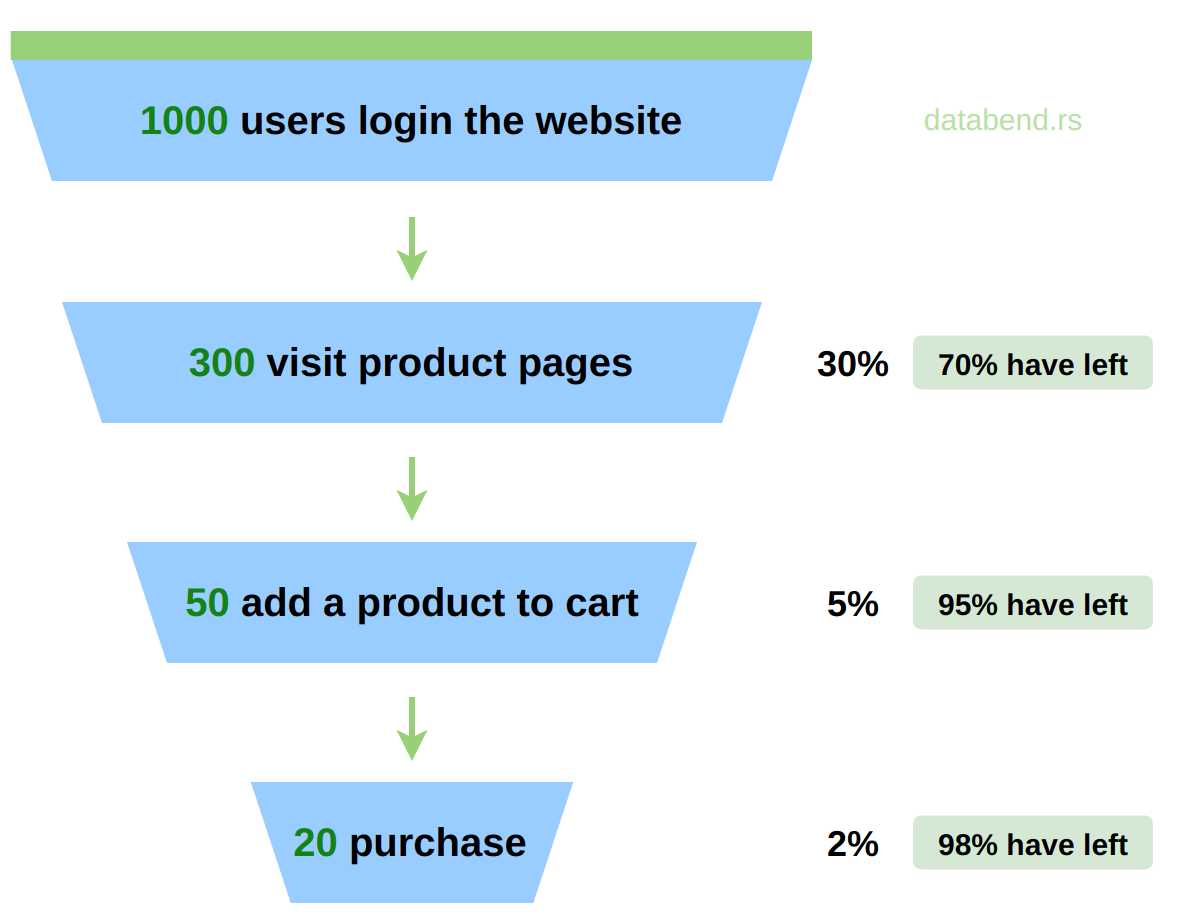
Similar to windowFunnel in ClickHouse (they were created by the same author), it searches for event chains in a sliding time window and calculates the maximum number of events from the chain.
The function works according to the algorithm:
-
The function searches for data that triggers the first condition in the chain and sets the event counter to 1. This is the moment when the sliding window starts.
-
If events from the chain occur sequentially within the window, the counter is incremented. If the sequence of events is disrupted, the counter isn’t incremented.
-
If the data has multiple event chains at varying completion points, the function will only output the size of the longest chain.
SQL Syntax
Section titled “SQL Syntax”WINDOW_FUNNEL( <window> )( <timestamp>, <cond1>, <cond2>, ..., <condN> )Arguments
<timestamp>— Name of the column containing the timestamp. Data types supported: integer types and datetime types.<cond>— Conditions or data describing the chain of events. Must beBooleandatatype.
Parameters
<window>— Length of the sliding window, it is the time interval between the first and the last condition. The unit ofwindowdepends on thetimestampitself and varies. Determined using the expressiontimestamp of cond1 <= timestamp of cond2 <= ... <= timestamp of condN <= timestamp of cond1 + window.
Returned value
The maximum number of consecutive triggered conditions from the chain within the sliding time window. All the chains in the selection are analyzed.
Type: UInt8.
Example
Determine if a set period of time is enough for the user to SELECT a phone and purchase it twice in the online store.
Set the following chain of events:
- The user logged into their account on the store (
event_name = 'login'). - The user land the page (
event_name = 'visit'). - The user adds to the shopping cart(
event_name = 'cart'). - The user complete the purchase (
event_name = 'purchase').
CREATE TABLE events(user_id BIGINT, event_name VARCHAR, event_timestamp TIMESTAMP);
INSERT INTO events VALUES(100123, 'login', '2022-05-14 10:01:00');INSERT INTO events VALUES(100123, 'visit', '2022-05-14 10:02:00');INSERT INTO events VALUES(100123, 'cart', '2022-05-14 10:04:00');INSERT INTO events VALUES(100123, 'purchase', '2022-05-14 10:10:00');
INSERT INTO events VALUES(100125, 'login', '2022-05-15 11:00:00');INSERT INTO events VALUES(100125, 'visit', '2022-05-15 11:01:00');INSERT INTO events VALUES(100125, 'cart', '2022-05-15 11:02:00');
INSERT INTO events VALUES(100126, 'login', '2022-05-15 12:00:00');INSERT INTO events VALUES(100126, 'visit', '2022-05-15 12:01:00');
Input table:
┌─────────┬────────────┬────────────────────────────┐│ user_id │ event_name │ event_timestamp │├─────────┼────────────┼────────────────────────────┤│ 100123 │ login │ 2022-05-14 10:01:00.000000 ││ 100123 │ visit │ 2022-05-14 10:02:00.000000 ││ 100123 │ cart │ 2022-05-14 10:04:00.000000 ││ 100123 │ purchase │ 2022-05-14 10:10:00.000000 ││ 100125 │ login │ 2022-05-15 11:00:00.000000 ││ 100125 │ visit │ 2022-05-15 11:01:00.000000 ││ 100125 │ cart │ 2022-05-15 11:02:00.000000 ││ 100126 │ login │ 2022-05-15 12:00:00.000000 ││ 100126 │ visit │ 2022-05-15 12:01:00.000000 │└─────────┴────────────┴────────────────────────────┘Find out how far the user user_id could get through the chain in an hour window slides.
Query:
SELECT level, count() AS countFROM( SELECT user_id, window_funnel(3600000000)(event_timestamp, event_name = 'login', event_name = 'visit', event_name = 'cart', event_name = 'purchase') AS level FROM events GROUP BY user_id)GROUP BY level ORDER BY level ASC;Result:
┌───────┬───────┐│ level │ count │├───────┼───────┤│ 2 │ 1 ││ 3 │ 1 ││ 4 │ 1 │└───────┴───────┘- User
100126level is 2 (login -> visit) . - user
100125level is 3 (login -> visit -> cart). - User
100123level is 4 (login -> visit -> cart -> purchase).